Kickoff
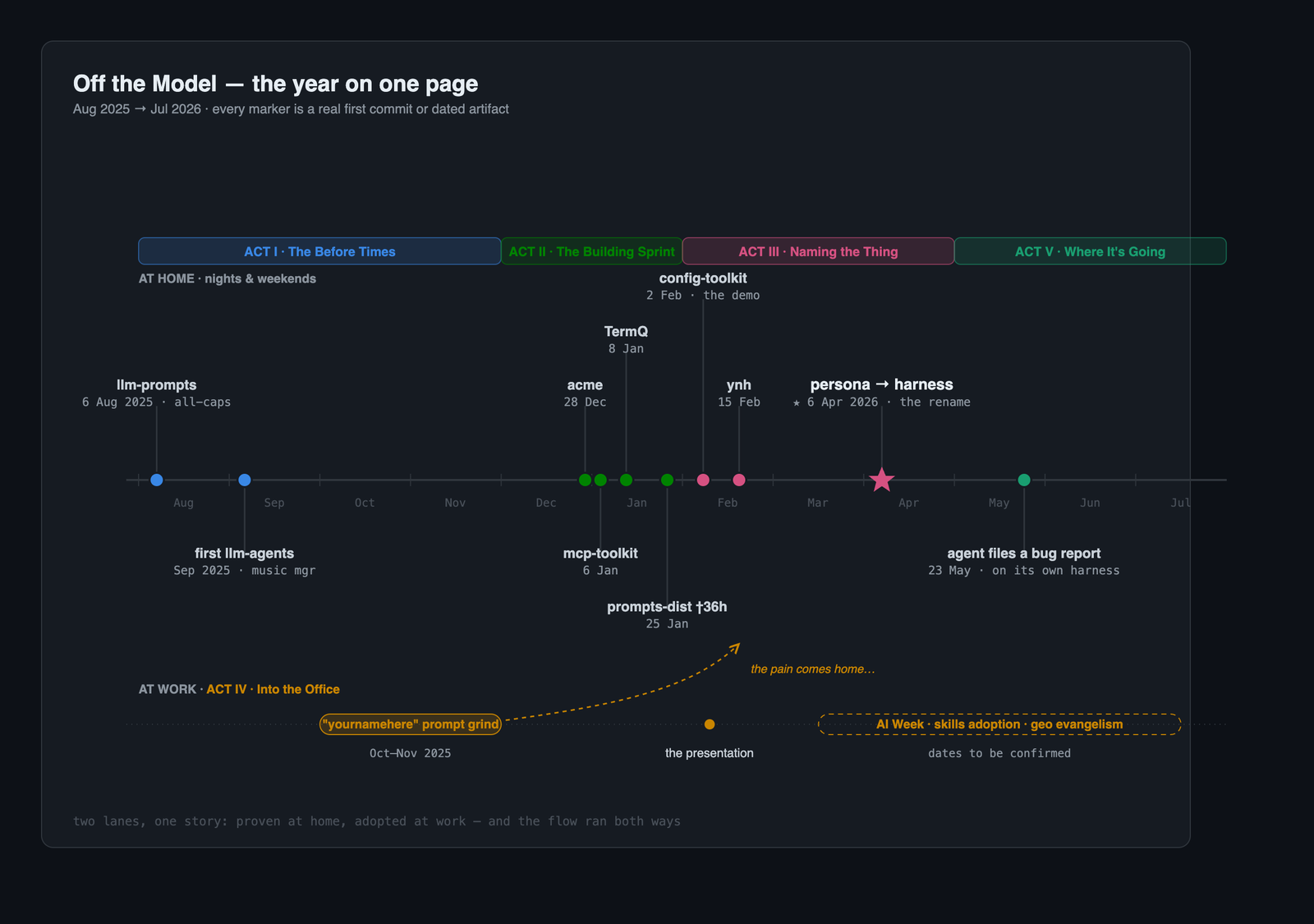
Eleven months. Seven repositories. Four abandoned projects. One rename that mattered. This is the last post of the series, so here’s the whole journey on one page — and the map I wish someone had handed me in August 2025.
The honest version of the arc: I shouted at a model in all-caps and organised prompts like a Victorian clerk. I automated my music downloads and accidentally learned what an agent was. A work project ran me into the prompt-era ceiling just before new models moved the bottleneck entirely. In three December weeks I started three systems — effort tracking, typed tools, an IDE conceived over dinner. I killed a project in 36 hours and kept its best organ. I rebuilt what I already knew, one weekend, so a room of colleagues could adopt it. A commit on April 6th gave the whole practice its true name — on the evening the first of four AI Week cohorts walked in. Over the next four weeks nearly forty colleagues spent a week each building, and every week built on what the last had left. And by May, one of my agents was filing bug reports on my harness from the inside — which is either the future arriving or the apprentice grading the master, depending on my mood.
The Run
The ladder
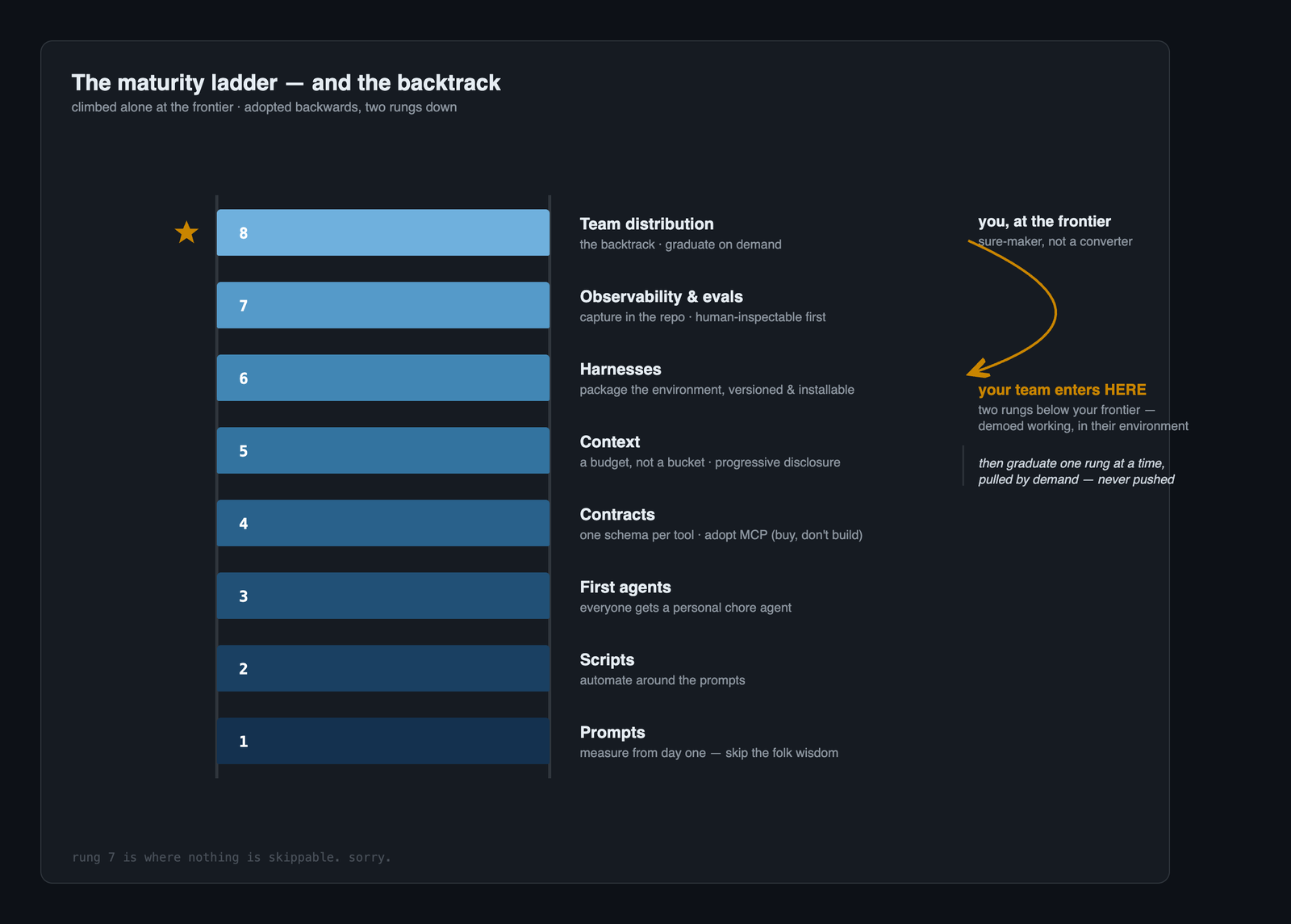
Along the way it became a ladder, and the ladder is the map:
Prompts → Scripts → Agents → Contracts → Context → Harnesses → Observability → Team distribution.
The last rung is a relay
Every other rung on this ladder I climbed alone. The last one can only be climbed in company, and it doesn’t really work like a rung. It works like a relay.
The pattern I watched across four consecutive weeks: someone builds something small for their own tedious task. On Friday they hand it on with one sentence (the golden ticket) and an honest list of what they didn’t get to (the wish list). The next cohort picks it up on Monday and pushes it one rung higher. Post 12 has the chains; my favourite is an anomaly-detection prototype that became a scheduled job, then a version that could explain why a number moved. Nobody planned it. The handover format did.
That is the shortcut I’d hand any team starting now. It isn’t a technology. It’s a week, a ritual, and a few rules:
- Start from a baseline that already exists — your vendor’s conventions, your company’s shared config. Fork it; don’t invent one.
- First skill: the most tedious, repeatable thing you do. Working by lunch, not polished.
- Describe the destination, not the route. The skills that worked best told the agent what done looks like and let it navigate, the way a sat nav takes a postcode, not turn-by-turn instructions.
- One skill, one job. Split anything that does two things; compose them later.
- Decide the shape deliberately: a skill for knowledge, an agent for a multi-step job, a queryable server for data that changes.
- Lint from day one. Silent metadata and untriggered skills are the bugs you’ll get otherwise (Post 14’s lesson, at team scale).
- Pre-provision access. The week dies on permissions, not scepticism.
- Hand over, every time. Golden ticket, wish list, demo to whoever is next.
The Debrief
The three expensive lessons
And the three lessons that cost the most:
The ladder is climbed alone and adopted backwards. Your frontier makes you sure; a stepped-back PoC makes your team start; a handover makes it compound. Budget for all three — they’re different jobs.
Failure is a harvesting problem. The four dead repos in this story yielded the evals insight, my daily tooling, the config taxonomy, and ultimately the harness concept itself. Kill fast; harvest deliberately.
Names are infrastructure. “How would we know?”, “context dilution”, “harness”, “the backtrack” — every phase of this journey turned on getting a name for the thing. When your team lacks a word, that’s the work.
On The Training Ground
Each post in this series carries its own Training Ground — a worked example to test that rung’s theory yourself. This capstone’s version is the whole course: climb the ladder above, one exercise per rung, in order. The individual posts have the details.
This series was built the way it preaches, incidentally: the research mined from real git history by agents, the posts drafted in a canonical repo, rendered to targets by a skill, reviewed by a human before anything shipped. The harness wrote its own biography, with supervision. And it’s printed on paper from the same forest: the site serving these words is the blog platform from that naive December weekend in Post 4 — a repo that then sat untouched for seven months, waiting, as it turned out, for the story of how it was built.
For the record, if you scrolled past the nav at the top of this page without clicking, this is technically the blog attached to a DJ mix archive. I am not a lawyer, a Victorian filing clerk, or a professional bug-report recipient. I am a person who once used a git hook to stop himself doing something a strongly-worded comment couldn’t, and eleven months later that turned into fifteen posts and a ladder. The mixes are still up there. So is the ladder. Take whichever one you came for.
Looking Ahead
Thanks for reading along. The repos keep going — stacked PRs, workspaces, behavioural evals — so there’ll be more to say. But if you take one line from all fifteen posts, take this one: the model was never the product. Build what surrounds it.